Press release · For immediate release
Rate Me and Tip Me: TapAPI lets patrons tip staff directly and gives venues first-hand service ratings
When patrons can tip from their phone, more of them tip and they tip more. TapAPI pairs every tip with a quick service rating, so venues see how their service is landing as it happens.

PRETORIA, South Africa, 17 October 2026 – Most patrons want to thank the people who serve them, but fewer of them carry cash. TapAPI, the South African tap-to-pay wallet company, has set out the evidence that letting patrons tip by phone lifts staff pay, morale and service, and how its Rate Me and Tip Me page lets a venue do it while monitoring its service first hand.
In a 2022 traveller survey by the digital tipping company Grazzy, 83% of hotel guests said they had wanted to tip a staff member but had no cash on them, and 98% said they would tip from their phone if they could. South Africa is going the same way: as people switch to cards, tap-to-pay and phone wallets, the workers who live on loose change are earning less each day.
More patrons tip, and they tip more
When tipping takes a phone instead of a banknote, more people do it and the amounts go up. The results below come from hotels and from South African car guards and fuel attendants.
| Where | What changed | Source |
|---|---|---|
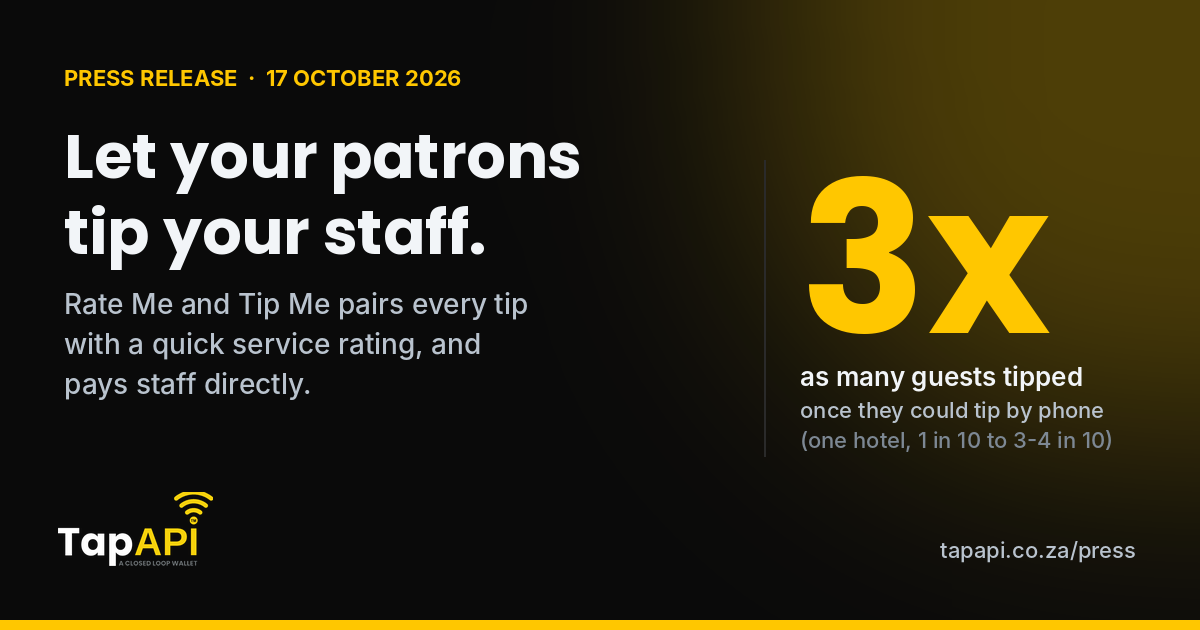
| A 150-suite Marriott hotel in Orlando, USA | Guests who tipped rose from 1 in 10 to 3 or 4 in 10. The average tip per room went from $3–4 to about $10, and cleanliness scores rose 10 points. | Hotel Tech Report |
| US hotels on one tipping platform | The average digital tip was $10, against $6 for the average cash tip. | Lodging Magazine |
| A 2023 survey of US hotel guests | 70% said they would tip more if they could tip digitally. | Hotel Dive |
| Wyndham hotels | Guests were more likely to tip once the staff member’s photo was shown beside the QR code. | The Points Guy |
| South African car guards and fuel attendants | Digital tipping raised their takings by as much as 40%. The average tip reached R30, with 12 to 20 tips a day. | TopAuto, EWN |
The photo finding matters most for staff whom patrons rarely meet, such as housekeepers. A name and a face turn an anonymous service into a person the patron wants to thank.
What a tip means to the person who earns it
For a worker on the national minimum wage, R30.23 for every ordinary hour since 1 March 2026, a single tip can equal an hour or more of pay. An average R30 tip is about an hour of minimum-wage work, and a R50 tip is more than an hour and a half. Twelve R30 tips in a day come to R360, about one and a half days of minimum pay. It is money staff take home on top of their wage, earned by the service they gave that day.
“Your patrons already want to thank your staff. Most of them simply have no cash on them. Give them a way to tip from their phone, pair it with a quick rating, and you hear how your service is landing from the people receiving it, while they are still in the building.”
— Charles Matthews, Co-founder and Director, TapAPI
Recognition keeps good staff
A tip is money, but it is also a named thank-you. Gallup and Workhuman followed more than 3,400 workers over two years and found that those who received high-quality recognition were 45% less likely to have left their job between 2022 and 2024. In a survey by a hotel technology company, nearly 80% of hotel employees said they would be more likely to stay with their employer if digital tipping were offered. Staff who work out of sight, in housekeeping, the kitchen or the grounds, hear from patrons for the first time.
Better service, better reviews, better rates
Better reviews let a venue charge more. A Cornell study found that a hotel whose review score rises by 1 point on a 5-point scale can raise its price by 11.2% and keep the same occupancy. When a short rating sits next to the tip, management learns which room, table or shift went well, and which did not, while the patron is still on site. A complaint caught that day costs far less than one posted online a week later.
Whose money is a tip?
The Restaurant Association of South Africa’s position is that a tip belongs to the staff member who earned it, not to the business, and that any sharing should follow a policy most of the staff agreed to. In 2023 the Labour Court upheld the dismissal of a waitress who kept a tip that such a policy required her to declare and share. SARS’s Binding Class Ruling 27, published in 2011, found that tips an employer held for safekeeping and passed on in full were not remuneration, so no employees’ tax was withheld on them.
The simplest arrangement for a venue is one where tips never pass through its books. A tip paid straight into the staff member’s own wallet leaves nothing for the venue to hold, count, share out or account for. This is general information, not legal or tax advice.
How Rate Me and Tip Me works
TapAPI gives each staff member their own Rate Me and Tip Me code and wallet, so the venue hears first hand how its service is landing and the patron’s thank-you goes straight to the person who earned it.
- A Tip Me badge is a button badge carrying the staff member’s own QR code, worn on the uniform. A Tip Card adds an NFC chip, so the patron can tap or scan. A room or unit card leads to the team that serviced it, for staff the patron never meets.
- The patron scans with their phone camera or taps the card, sees who they are thanking, answers a few quick rating questions, then chooses a tip. No app is needed.
- Every rating is filed against the staff member and the location, so a low score points to one person, one room or one shift. Managers see the results on their dashboard while the patron is still on site.
- Each location can ask its own questions, such as cleanliness, friendliness or speed.
- Tips go straight into the staff member’s TapAPI wallet and never pass through the venue’s books. TapAPI takes no fee on tips; the only deduction is the payment method’s own cost.
- Hotel groups and larger venues can run it under their own brand.
- Wallet data is kept on servers in South Africa, and TapAPI is registered with the Information Regulator under POPIA.
Making it work at a venue
- Put a name and a face on it. Show the staff member’s first name and photo where the patron tips, with the staff member’s consent.
- Ask nothing of the patron. No app and no account: scan a code or tap a card, choose an amount, done.
- Pay the person, not the business. If the team shares tips, write the split down and have the staff agree to it.
- Keep the ask light. Tipping is a choice. Suggested amounts help, pressure does not.
- Make clear the tips are extra. Wyndham found housekeepers warmed to digital tipping once management showed it added to what they already received.
- Guard against fake codes. A printed QR code can be covered with a fraudster’s sticker, so use codes tied to a registered staff member and check them on your rounds.
Availability
Tip Me badges cost R35 each, with delivery to a PAXI point at R59.95, and can be ordered at tapapi.co.za/order.php. To set up Rate Me questions, room and unit cards, or a branded rollout across a group, contact help@tapapi.co.za.
– ENDS –
Notes to editors: sources
- How digital tipping enhances the guest experience, Grazzy (2022 Traveler Survey).
- New cashless tipping option rolls out for car guards and petrol attendants, Briefly News.
- SpringHill Suites by Marriott Orlando Lake Buena Vista South digital tipping case study, Hotel Tech Report.
- 6 advantages to implementing an e-tipping solution, Lodging Magazine.
- Wyndham CIO on how mobile tipping can boost guest, employee satisfaction, Hotel Dive.
- Wyndham mobile tipping for hotel housekeeping, The Points Guy.
- With mobile tipping, hoteliers aim to ease housekeeper staffing problems, CoStar.
- Car guards in South Africa making R600 a day, TopAuto.
- Car guards now getting average R30 tip through digital tipping, EWN, 13 May 2025.
- New national minimum wage rates announced for 1 March 2026, Acts Online, 5 February 2026.
- Want to keep good workers? Praise them, a new study finds, NPR via GPB, 18 September 2024.
- The impact of social media on lodging performance, Chris Anderson, Cornell Center for Hospitality Research, 2012.
- Tips belong to waiters, not restaurants – industry expert clarifies, EWN, 31 December 2025.
- Waitress loses job after keeping R150 tip that was meant to be pooled, Pretoria News, 6 July 2023.
- Binding Class Ruling 27: tips held for safekeeping by employers and subsequently paid over to employees, SARS.
About TapAPI
TapAPI is a South African closed-loop prepaid wallet operated by TAPAPI (Pty) Ltd (registration 2026/529514/07), Pretoria. People pay with a tap of an NFC wristband or tag at TapAPI shops, events and tills, get tipped by a scan of a Tip Me badge, and businesses take payments on their own Android phones or Windows PCs. tapapi.co.za
Media contact
Charles Matthews
Co-founder and Director, TapAPI
help@tapapi.co.za
The image above may be used with this release.