Press release · For immediate release
TapAPI wristbands stop year-end function bar tabs from leaking
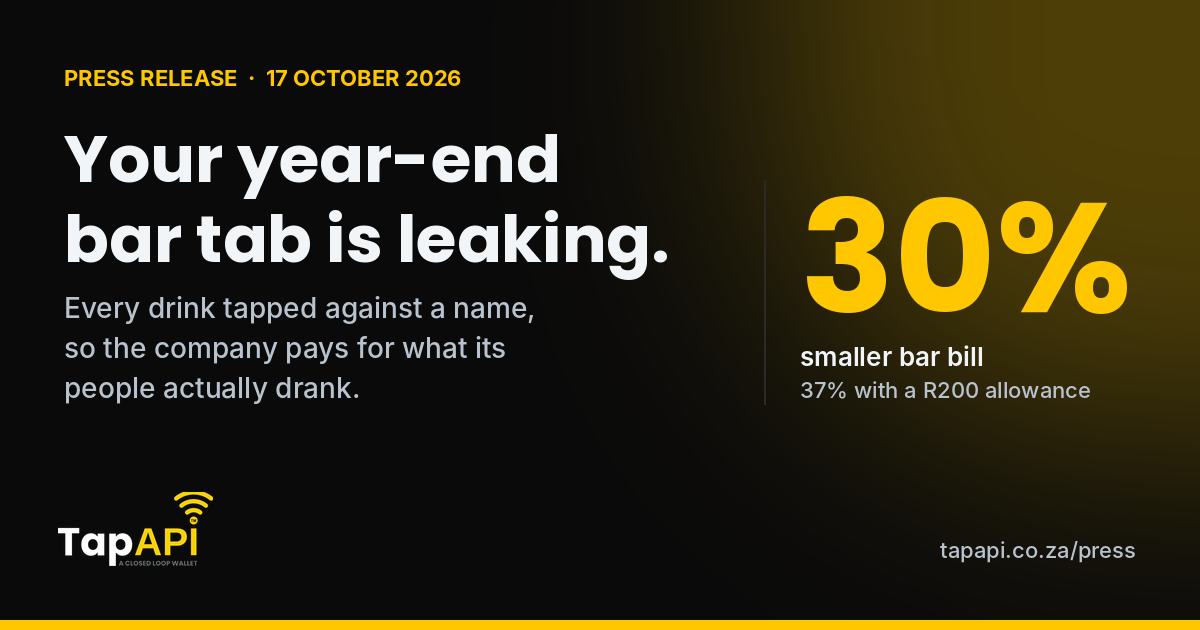
A 100-person company function can cut its bar bill by about 30%, and by about 37% with a fixed drinks allowance on every wristband.

PRETORIA, South Africa, 17 October 2026 – TapAPI, the South African tap-to-pay wallet company, has opened orders for company function wristbands that record every drink at a year-end function against the name of the staff member who ordered it. TapAPI’s model of a 100-person function shows the bar bill falling from about R32,900 to R23,100, a saving of about 30%. With a R200 drinks allowance loaded on each wristband, the bill falls to about R20,600, and the company knows its maximum spend before the first drink is poured.
Year-end functions start in about six weeks. For most companies the bar is the biggest cost on the night that nobody controls: the venue sends a bill the next morning, and nobody at the company can check it.
Where the money goes
Function bars bill in one of two ways, and both put the bar’s losses on the client’s invoice. Some count the stock at the start and end of the night and bill whatever is gone, so every over-pour, spill, dropped bottle and bottle that leaves through the back door is billed as if a guest drank it. Others bill from the bar staff’s own tally, which the client has no way to check.
The beverage auditing firm Bevinco found that bars lose on average 23% of their liquor and draught beer to over-pouring and theft, with figures for Canada, the UK and Australia between 10% and 17% (Beverage Information Group). A year-end function sits close to the worst case: the bar staff are hired for one night, nobody measures the pours, and the client keeps no stock count of its own.
“Most companies sign the venue contract without asking how the bar will be billed. When every drink is tapped against a name, the company pays for what its people actually drank, and it knows its maximum spend before the night starts.”
— Charles Matthews, Co-founder and Director, TapAPI
How it works
Each staff member wears an NFC wristband linked to their own TapAPI wallet. The barman rings up the drink on a phone till or on the venue’s Windows point-of-sale PC, and the guest taps. Every drink is recorded with a name, a time and a till, which closes five leaks:
- The bill becomes the tap report. If the venue agrees to bill only what was tapped, over-pours, spills and missing bottles become the venue’s cost, not the company’s.
- No band, no drink. Partners, drivers, venue staff and gate-crashers can no longer drink on the company tab. Unlike paper drink tickets, which guests simply collect from friends, a band on a wrist is not easily handed around, and a drink bought for someone else is recorded against the person who bought it.
- Named drinks are drunk more slowly. When people know each drink is logged against their name, the heaviest drinkers tend to pace themselves. TapAPI’s model assumes a modest 10%.
- The allowance is the cap. The company loads each band with a fixed amount, say R200, and staff top up their own band if they want more. Nobody has to police it at the bar.
- Breakages get a name. A broken glass can be logged against the band of whoever broke it. The model assumes this halves the breakage bill.
What it adds up to
| Line | Open bar, billed on stock | TapAPI tab | TapAPI, R200 allowance |
|---|---|---|---|
| Staff drinks | R25,000 | R22,500 | R20,000 |
| Non-staff drinking on the tab | R2,500 | R0 | R0 |
| Over-pours, spills, missing stock | R4,125 | R0 | R0 |
| Breakages | R1,250 | R600 | R600 |
| Total | R32,875 | R23,100 | R20,600 |
| Per head | R329 | R231 | R206 |
| Saving | R9,775 (30%) | R12,275 (37%) |
The saving scales with headcount: for 200 staff, a tracked tab saves about R19,500. The figures are before TapAPI’s own costs. The assumptions are in the notes below.
Safer nights, not only smaller bills
A capped band stops on its own when the allowance runs out. Without a cap, the record still shows who has had eight drinks by 21:00, so the organiser can slow someone down, steer them to the food or call them a lift before it becomes a problem. If something does go wrong, the company has a factual record instead of competing memories.
Availability and pricing
Company function wristbands can be ordered now at tapapi.co.za/order.php?for=function, for functions of 20 to 2,000 guests. Larger functions are quoted by email.
- R75 per wristband for up to 50 guests, R65 from 51 to 500 guests, and R55 above 500. Each wristband comes with its own claim card, and each guest opens a free wallet with it.
- Courier delivery to the business address: R150 for every 250 wristbands.
- Company branding from 500 wristbands, at R5 extra per band, in the company’s chosen colour and artwork, with a six-week lead time from payment.
- From 1,000 wristbands, the company can run its staff wallets under its own name as a TapAPI tenant.
- Bar staff can use their own Android phones as TapAPI tills, at R25.25 per till for each day it is used. A venue that prefers its counter PC can run the till on Windows with a once-off R499 kit: a tag reader, a PIN keypad, a USB splitter and the software key.
- Companies can save a quote, valid for seven days, add their own order number to turn it into a pro forma invoice, and pay online by instant EFT, card or PayShap. TapAPI is not registered for VAT, so no VAT is added.
Advice for organisers
- Put the billing clause in the venue contract. Agree that the bar bill is the TapAPI tap report. Without it, the venue can still bill on its stock count, and only the cap and the non-staff savings remain.
- Set up the bar. Phone tills need Android phones with Chrome and NFC switched on; a PC till needs the R499 kit.
- Tell staff before the night. Explain the bands, the allowance and what happens past it.
- Decide who sees what. A drinks log per person is personal information under POPIA. Decide up front who may see names and who only sees totals, and tell staff.
- Pitch the allowance with care. Set it around what a typical guest drinks, so only the heavy tail pays its own way.
Year-end dates fill fast and venue contracts are signed weeks ahead, so the time to arrange a tracked bar is when the venue is booked, not on the night.
– ENDS –
Notes to editors
The model assumes 100 staff, a five-hour function, an average drink of R50 and five drinks per person. Non-staff drinking adds 10%, and leakage on a stock-count bill adds 15%, below Bevinco’s 23% average. Named drinks cut staff consumption by 10%, and about 25 glasses break at R50 each. In the allowance column the full R200 per head is counted as spent, even if some is left on the bands. Figures exclude the wristbands, phone till fees and PC kits.
- Sticky Fingers, Beverage Information Group (2009): Bevinco’s shrinkage figures by country.
- Holiday Parties With Open Bars: Mistake or Necessity?, BizBash (2014): event professionals on drink tickets and staff safety.
About TapAPI
TapAPI is a South African closed-loop prepaid wallet operated by TAPAPI (Pty) Ltd (registration 2026/529514/07), Pretoria. People pay with a tap of an NFC wristband or tag at TapAPI shops, events and tills, get tipped by a scan of a Tip Me badge, and businesses take payments on their own Android phones or Windows PCs. tapapi.co.za
Media contact
Charles Matthews
Co-founder and Director, TapAPI
help@tapapi.co.za
The image above may be used with this release.