Press release · For immediate release
Every second at the till has a price: how South African counters can cut festive-season queues
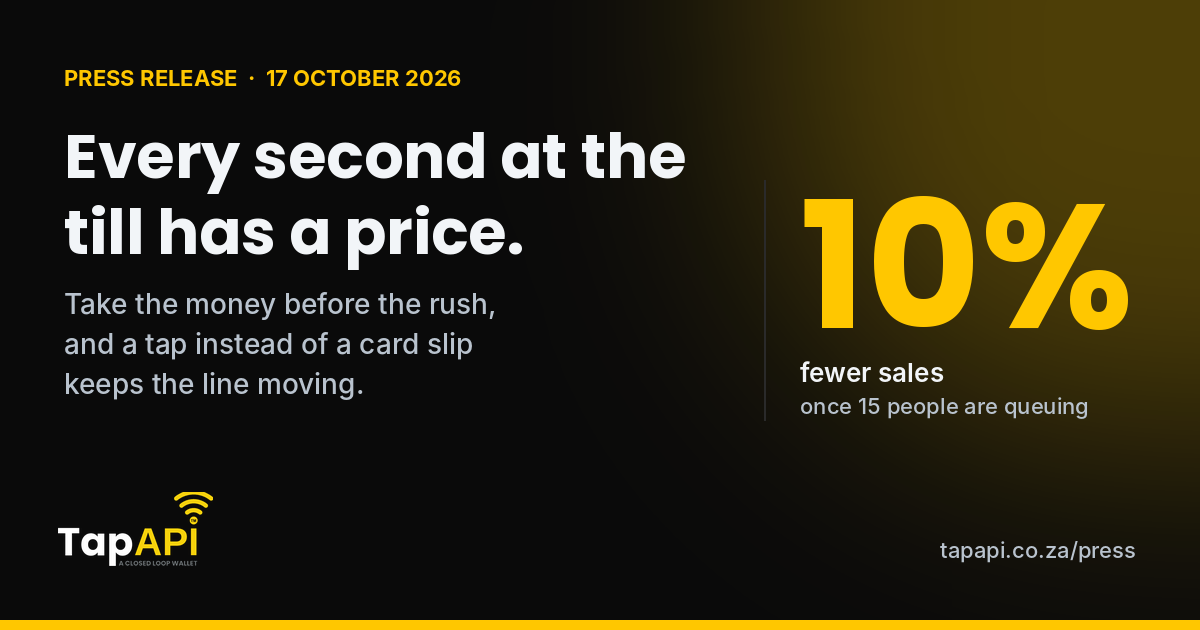
Research shows sales fall by about 10% once 15 people are queuing. Taking the money before the rush, and a tap instead of a card slip, keeps the line moving.

PRETORIA, South Africa, 17 October 2026 – A long queue costs a business sales that never show up in its reports. The customer who sees the line, puts the basket down and walks out leaves no transaction, no refund and no complaint. Ahead of the festive season’s busiest trading weekends, TapAPI, the South African tap-to-pay wallet company, has set out what the research says about queues and payment times, and how taking the slowest steps out of each payment keeps the line moving.
The damage is worst when businesses can least afford it: the Friday and Saturday peak, month-end, half-time at the bar and the rush after the speeches at a year-end function. Those are the minutes when the most money wants to change hands, and the queue decides how much of it actually does.
Customers count heads, not minutes
Shoppers decide whether to join a line by how long it looks, not how fast it moves, and once it passes about ten people, sales drop quickly. The clearest evidence comes from a seven-month study at a busy supermarket deli in Santiago, Chile, where researchers photographed the queue every 30 minutes and matched each snapshot to 284,709 till transactions from loyalty-card shoppers, published in Management Science in 2013 (Lu, Musalem, Olivares and Schilkrut). Four findings matter for any business with a counter:
- People reacted to the number of customers waiting, not to the number of staff serving. An extra server nobody notices does not stop people walking away.
- The effect is not gradual. Below about five people it barely registers; at 15 or more, the share of shoppers buying fell from 30% to 27%, a 10% loss of sales.
- Growing the line from 5 to 10 people put customers off as much as a 3.2% price rise. Growing it from 10 to 15 was like an 8.3% price rise.
- The shoppers least willing to wait were also the least price-sensitive, and that group spent about 40% more per visit. A long line drives away the best customers first.
An average waiting time hides the damage. What costs money is how often the line gets long, so that is the number to watch.
“The sale you lose to a long queue never shows up in your reports. Take the money before the rush, so the counter only has to take a tap, and every till you already have serves more people on the nights that matter.”
— Charles Matthews, Co-founder and Director, TapAPI
Why five minutes can feel like twenty
How long a wait feels depends on what happens during it, so part of the queue problem can be fixed without serving anyone faster. Service researcher David Maister set out the rules in his 1985 paper The Psychology of Waiting Lines: satisfaction is what customers perceive minus what they expected, and both can be managed.
| What Maister found | What it means at the counter |
|---|---|
| Idle time feels longer than occupied time | Put the menu and prices where the line can read them, so people choose before they reach the till. |
| Waiting to start feels longer than waiting once service has begun | Acknowledge the line early. A nod, a “with you shortly” or a runner taking orders tells people they are in the system. |
| Uncertain waits feel longer than known ones | If there is one long line, say roughly how long it is. |
| Unexplained waits feel longer | If the card machine has lost signal, say so instead of shrugging. |
| Unfair waits feel longer | Keep one visible order. Nothing sours a bar faster than someone being served out of turn. |
| The smaller the purchase, the less patience people have | A customer buying one cold drink tolerates far less waiting than one buying a trolley of groceries. |
| Waiting after the service is done feels longest of all | Once the drink is poured, every second spent on payment is the most irritating part of the visit. |
That last row is the one most businesses overlook. At a bar the product is already in the customer’s hand when payment starts, so a card machine searching for signal, a PIN typed twice or a hunt for change is exactly the kind of wait people resent most.
Where the seconds go
Payment is the part of a sale that can be sped up most, because the slow parts of a card payment are extra steps, not extra service. Researchers in Poland filmed 3,728 checkouts in convenience stores and timed every stage of each payment (Polasik and others, 2012).
| Payment method | Seconds |
|---|---|
| Phone app, codes typed in | 56.5 s |
| Card and PIN | 48.0 s |
| Card and signature | 40.3 s |
| Contactless, online, slip printed | 37.1 s |
| NFC phone and PIN | 31.7 s |
| Contactless phone sticker | 29.5 s |
| Cash | 28.9 s |
| Tap, no slip, no online approval * | 24.3 s |
* Estimated by the researchers by simulation, as too few of these payments could be timed live. Polasik and others (2012): 3,728 checkouts timed from video in Polish convenience stores, November 2009, payment stage only.
The delay in a card payment sits in steps that must happen one after another: waking the terminal, typing the PIN, waiting for the bank to approve, printing the slip. The researchers put slip printing at about 6 seconds and online approval at about 7. Take those out and a tap beats counting out cash and change.
Germany’s central bank found the same pattern when it timed more than 3,000 payments at 15 retailers in 2017: cash about 22 seconds, card and PIN about 29, card and signature about 38 (Deutsche Bundesbank). Seconds sound trivial until they are multiplied: saving 24 seconds on each of 300 payments on a Friday night frees two full hours of till time, with no extra staff.
The South African picture
South African tills are busiest on Fridays and Saturdays and still handle mostly cash, so the payment step weighs more here than in the countries where most queue research is done. The Reserve Bank’s first payments study found that cash made up 56% of all payments, and that Fridays and Saturdays are the busiest payment days while Tuesdays are the quietest (BusinessDay, September 2024). Its Cost of Cash study, released in September 2026 with 2024 as the base year, puts the cost of the country’s cash habit at R88.5 billion a year (Daily Investor).
Cash is not going anywhere soon: only 39% of informal traders accept electronic payments, and 55% of low-income South Africans rely on cash alone, yet 59.8% of those surveyed said they would rather pay electronically. A busy counter has to take cash, but every cash sale in a rush means counting, change and a float to guard. The fix is to handle the cash once, before the rush, instead of hundreds of times during it.
Bars, events and functions
A bar is the worst case for a slow payment: small orders, a product already poured, and a crowd that arrives all at once at half-time, between acts or after the speeches. Festivals that moved to prepaid wristbands report what happens when the payment step shrinks:
- The UK’s 2000trees festival (10,000 capacity) went fully cashless in 2018. Organisers said bar transactions averaged 40 seconds per customer, queues almost disappeared and bar sales rose significantly. More than 80% of visitors loaded money before arriving (Festival Insights).
- Northern Ireland’s Jika Jika festival, also in 2018, reported spending per head 23% higher than at the organisers’ earlier non-cashless events on the same site (Festival Insights).
These are organiser and supplier reports, not controlled studies, but they point the same way as the research: take the money before the rush, and the rush moves faster. Company year-end functions are the same problem in a smaller room, where the usual choice is a cash bar that embarrasses guests or an open tab nobody can account for afterwards.
Seven ways to shorten the line
- Count heads, not minutes. At the busiest hours, note how many people are waiting every 15 minutes, and track how often the line passes ten. That is where sales start to leak.
- Make the line look as fast as it is. People judge by length. With one long line, show the expected wait; with several tills, keep each line short and visible.
- Take the money before the rush. Sell credit at booking or at the entrance, so the bar only has to take a tap. A top-up point away from the bar keeps cash out of the serving line.
- Cut steps out of every payment. Skip printed slips unless asked, avoid PIN entry on small amounts where the system allows it, and put prices where people decide before they order.
- Open lanes when the wave comes. If a spare phone can become a till for the evening, a lane can be added at half-time instead of watching the line grow.
- Acknowledge everyone. A runner taking orders, or a simple “two minutes”, makes the same wait feel shorter.
- Staff for the peak, not the average. Plan Friday and Saturday evenings, month-end and event breaks first, and let the quiet hours look after themselves.
How TapAPI shortens the line
TapAPI turns each payment into a tap against a prepaid wallet, which removes the slow steps the research points to.
- Pay with a tap. Customers carry an NFC wristband, tag or card linked to their TapAPI wallet. They load it once, online or with cash at a TapAPI till, then tap to pay.
- No slip, no wait for a bank. Each tap is checked against money already loaded, and every sale lands on the customer’s wallet statement instead of a paper slip.
- Cash handled once. Cash customers top up at the entrance or a top-up point, so the bar only takes taps. A band works without a bank account, and a cell number is optional but lets the holder recover the money if the band is lost.
- Extra tills when you need them. Any Android phone with NFC and Chrome can be invited as a till by SMS, and is paid for only on the days it is used, at R25.25 a day. A counter with a Windows PC can run the till with a USB tag reader, part of a once-off R499 kit.
- Year-end functions. Staff bands record every drink against a name, so the company pays only for what was poured and sees exactly where the money went (see the year-end bar tab release). Company branding is available from 500 bands.
- Local and registered. Wallet data is kept on servers in South Africa, and TapAPI is registered with the Information Regulator under POPIA.
Businesses can become a TapAPI shop at tapapi.co.za/vendor.html, and companies can order function wristbands at tapapi.co.za/order.php?for=function.
– ENDS –
Notes to editors: sources
- Measuring the Effect of Queues on Customer Purchases, Lu, Musalem, Olivares and Schilkrut, working paper version; published in Management Science 59(8), 2013.
- The Psychology of Waiting Lines, David Maister, 1985.
- Chronometric Analysis of a Payment Process for Cash, Cards and Mobile Devices, Polasik and others, ICEIS 2012.
- Study finds that cash payments are quick and cheap, Deutsche Bundesbank.
- Cash remains king in SA, Bank study shows, BusinessDay, 5 September 2024.
- Cash is still king in South Africa, Daily Investor, 19 September 2026.
- 2000trees enjoys fully cashless success, Festival Insights, 5 September 2018.
- Northern Ireland’s first ever cashless festival, Festival Insights, 6 September 2018.
About TapAPI
TapAPI is a South African closed-loop prepaid wallet operated by TAPAPI (Pty) Ltd (registration 2026/529514/07), Pretoria. People pay with a tap of an NFC wristband or tag at TapAPI shops, events and tills, get tipped by a scan of a Tip Me badge, and businesses take payments on their own Android phones or Windows PCs. tapapi.co.za
Media contact
Charles Matthews
Co-founder and Director, TapAPI
help@tapapi.co.za
The image above may be used with this release.